
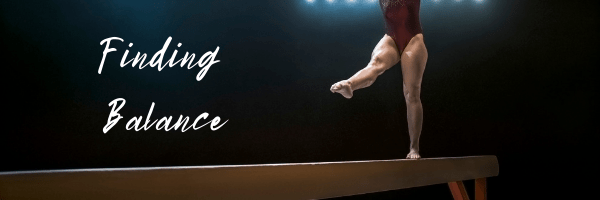
All of my kids did gymnastics. So many of the skills that a gymnast does don’t really look that hard until you try them as a non-gymnast. That is most true on the balance beam. The reality is that it is hard enough just to walk back and forth on a four inch wide beam, however far those things are off the ground. So then when you are asked to jump or turn, there is a good chance you will swing your arms or just fall off completely. Those gymnasts doing back handsprings or sheep jumps are also experts and falling off the beam.
So where am I going with this as it relates to writing, and writing with a partner, or someone who has hired you to help with your writing?
All good writing starts with a question. Today, my question is, How do you find balance?
balance [ bal-uhns ] (noun)
A state of equilibrium or equipoise; equal distribution of weight, amount, etc. Something used to produce equilibrium; counterpoise. Mental steadiness or emotional stability; habit of calm behavior, judgment, etc.
I actually had a hard time not just copying all the definitions for balance. There was even one that had to do with wine, who knew.
But to achieve balance, you have to make an abundance of infinitesimal shifts and adjustments. If any of those shifts or adjustments are too big, your chance of tipping over increases by a substantial percentage.
So what are we trying to balance here? First, let’s talk about the writing. You have your first draft. It needs work. You need to shift words, change words, show not tell, add more dialogue. The first time you try a cartwheel on the balance beam, you are going to have to change 90% of what you are doing so that you can successfully hold your hands up in the air and stay standing at the end of that cartwheel. Each change, each adjustment, is teaching our writing mind more about writing. Don’t resent that time or all those changes.
So the other balance I was thinking of is working with other people. People are always tricky because, at first you don’t really know what they are doing or intending. You don’t know their skill, and you don’t know how they will react. It takes some balance to figure that out. Little adjustments, sometimes you both fall off the beam because one or both of you misread a situation. Be willing to get back up. The skills of a good coach can’t be underestimated. Sometimes I would try to help my kids do some sort of simple tumbling move, and it was not uncommon for me to just get kicked in the face, but my son’s coach could manage to get his hand on his back four or five times when he was doing a complicated tumbling run, like a double front flip, with a tuck, and a full. Later, the same son progressed to cheerleading. He reached a point where he could have a girl doing flips on one of his hands. That is some insane balance partnership going on! (I try to channel those girls when I’m attempting some sort of yoga balance, it never works.)
So working together, you have to take the time to get the balance. You need to respect what the other person is bringing to the table, and when you suggest changes and adjustments, do it carefully so that there are no injuries! Shift, adjust, repeat.
With a little luck, you can put the whole thing together into that full routine or a wonderful book.
 writingwithshannon.com
Leave a comment